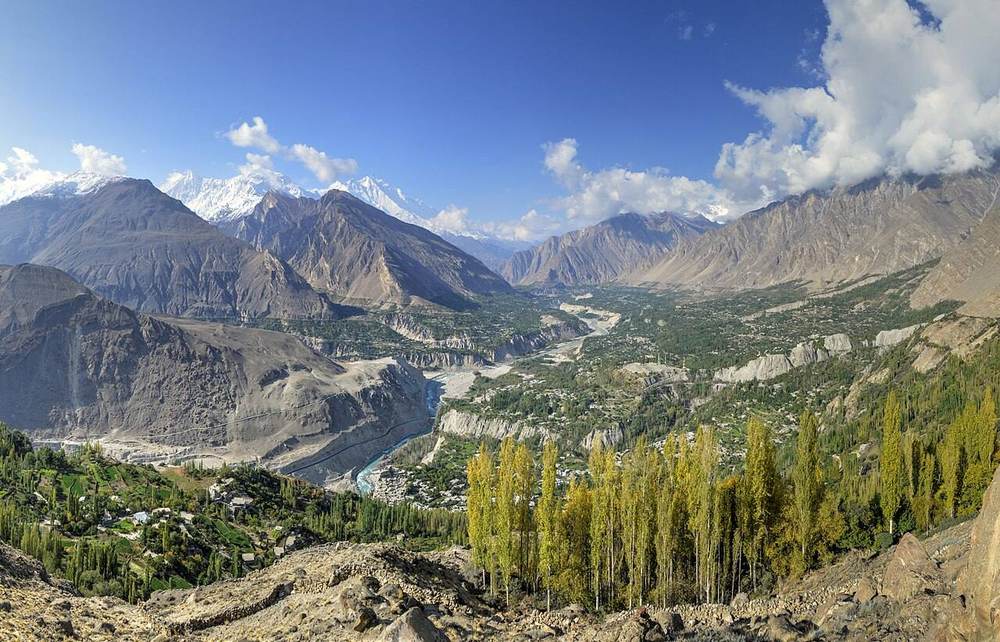
Photo: Hunza Valley from Eagle's Nest — CC BY-SA 4.0, via Wikimedia Commons (see photo credits)
Best Time to Visit Hunza Valley: A Month-by-Month Guide
Hunza looks different every month — pink blossoms in spring, green meadows in summer, gold in autumn and white silence in winter. This guide breaks down Hunza Valley weather by month, road conditions and the best season for your kind of trip, so you can book with confidence.
What is the best time to visit Hunza Valley?
The best time to visit Hunza Valley depends on what you want to see. For most travellers, mid-September to early November wins: the famous golden autumn, harvest season, comfortable 5–15°C days and thinner crowds than summer. Late March to April is the pick for blossom lovers, while June to August gives the warmest weather and access to every viewpoint, including Khunjerab Pass. Winter (December–February) is beautiful but demanding.
Hunza Valley weather by month
Hunza sits around 2,500 metres above sea level at Karimabad, so days are pleasant but nights stay cool even in summer. Here is what each season brings:
Spring: March to May — blossom season
Summer: June to August — peak season
Autumn: September to November — golden season
Winter: December to February — snow season
Are the roads to Hunza open all year?
The Karakoram Highway from Islamabad/Rawalpindi to Hunza (roughly 600 km, 14–18 hours by road) operates year-round in principle, but winter snow and summer monsoon landslides can close sections for hours or days. Flights from Islamabad to Gilgit are a faster alternative when they operate, though they are frequently delayed by mountain weather — never plan a tight connection on the same day. The Khunjerab Pass (Pakistan–China border, a highlight day trip from Hunza) is generally open May to October only.
Best time to visit Hunza with family
May, June and September are the sweet spots for family trips: mild weather, fully open roads, and manageable crowds compared to the July–August rush. Daytime temperatures suit children and elders, hotel choice is wide, and boat rides on Attabad Lake run normally. Avoid deep winter with small children — heating can be limited in valley hotels.
Best time for photographers
Photographers plan around two windows: late March to mid-April for blossom season (pink and white orchards against snow peaks) and mid to late October for golden autumn. Both offer the sharp, clear air that makes Hunza famous. Sunrise from Eagle's Nest above Karimabad is the classic shot in any season.
Cheapest time to visit Hunza
November to March is the budget window — hotels that stay open offer their lowest rates and transport is negotiable. The trade-off is real: cold weather, limited services, possible road delays and no Khunjerab access. For the best balance of price and experience, target the shoulder weeks of late April or early November.
What to pack for Hunza in each season?
Summer (Jun–Aug): light clothes for the day, a warm fleece or jacket for evenings, sun cap, sunscreen and sunglasses (high-altitude UV is strong), and sturdy walking shoes for fort climbs and village trails.
Spring/Autumn (Mar–May, Sep–Nov): layered clothing — thermal base, sweater, windproof outer shell. Mornings and nights are cold even when afternoons are mild.
Winter (Dec–Feb): heavy down jacket, thermal innerwear, gloves, warm cap, wool socks and waterproof boots. Carry a power bank — long travel days on the KKH drain phones fast.
How many days do you need for Hunza?
Five full days is the practical minimum: a day each for Karimabad with the Baltit and Altit forts, Attabad Lake and Passu, the Khunjerab day trip, plus travel days on the KKH. That matches our 5-day Hunza Tourism & Tourisem Explorer (Gilgit–Hunza, Karimabad forts, Attabad–Passu, Khunjerab route). With 7–8 days, combine Hunza with Skardu — the Hunza & Skardu Megatour Package covers both valleys plus Deosai. See all options on our tour packages page or browse destinations for ideas.
How to book a Hunza tour with GB Adventure?
Pick a package that matches your dates on the packages page, submit the booking form, and our team confirms hotel, transport and the day-wise plan on WhatsApp before you travel. Customisation is free — routes, dates and pace can be adjusted for families, couples and groups. For a broader overview of the valley, read our Hunza Valley travel guide.
Frequently asked questions
What is the best month to visit Hunza Valley?
Is the road to Hunza open all year?
When is cherry blossom season in Hunza?
Is Hunza worth visiting in winter?
How many days are enough for Hunza?
What should I pack for Hunza?
Ready to see Hunza in its best season?
Tell us your dates — we will match you with the right Hunza package and handle hotels, transport and the full plan.
View Hunza Packages Book NowPublished 3 October 2026 · GB Adventure Journal · All articles